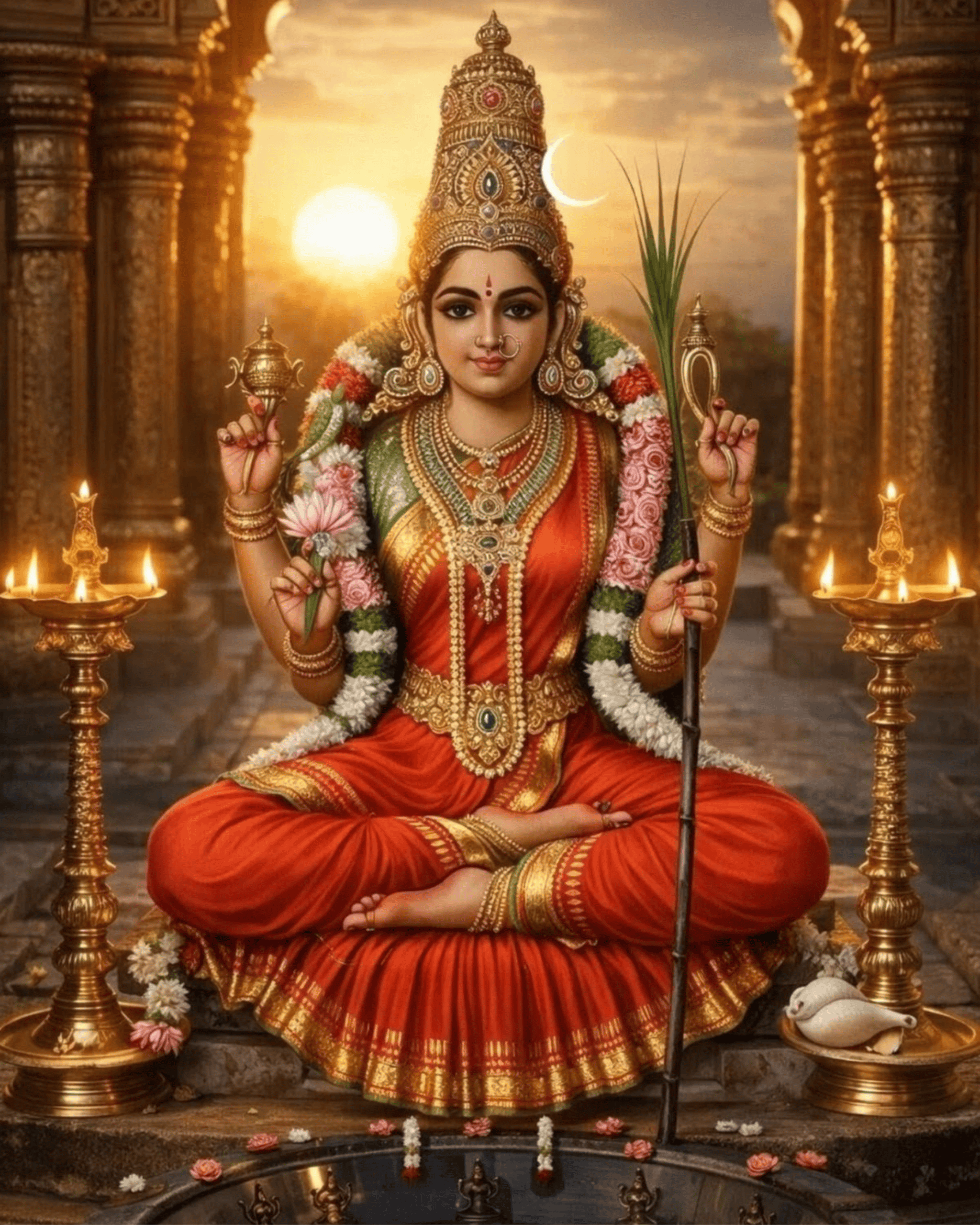

The inner mechanics of puja and japa, and why the divine response arises from within.
Before I begin, I bow down to the entire Gurumandala. The clarity in these insights comes from my Gurudeva, Sri Atmanandanatha of the sacred Guhananda Parampara of Sri Vidya Tantra, who unfolded them during the Gyana Yagna. I am only sharing them here in the simple way I understood while listening.
We all have our ways of praying — some chant mechanically, some devotionally, some with curiosity, and some simply because it is tradition. But rarely do we pause to ask what is actually happening inside when we sit down for puja or japa.
The interesting part is that something begins to shift in us the very moment we start. Without effort, our attention draws inward. The sound of the mantra begins to vibrate through the system. And the feeling or intention behind the practice — our bhāva and saṅkalpa — quietly awakens. These three movements, chitta-ekāgratā, nāda, and bhāva–saṅkalpa, come together like three notes forming a chord.
When they align, the structure of our awareness begins to reorganize.
This is important to understand: awareness is not an empty, passive space. It has a structure, just like a seed or a tree has structure. And that structure is sensitive. When attention steadies, when sound vibrates, and when intention participates, something inside begins to rearrange itself.
We feel this rearrangement as small shifts — clarity settling in, restlessness rising and later turning into strength, fear surfacing and dissolving, or a sudden patch of silence appearing out of nowhere. These are not mysterious signals from the outside. They are the system responding from within.
Yet the mind interprets this inner movement as an external presence. Fear arises inside but feels like something is coming toward us. Love arises inside but feels like someone is holding us. Stillness arises within but feels like a blessing placed upon us. Consciousness naturally misreads its own deeper functions as “the other.”
This is why the inner shift created by japa feels like a Devata responding.
But what we call “response” is simply the activation of a deeper function of our own awareness — a specific pattern becoming active, a new perception stabilizing, a latent energy beginning to operate. It is like living in a familiar house and suddenly noticing a small door you had walked past for years. The door was always there. You simply didn’t have the eyes to notice it.
A mantra works exactly like a key. It doesn’t create new rooms inside us; it opens the ones that already exist.
Strength is already in the body. Exercise doesn’t import it from outside — it makes it accessible. A stone falls not because someone pushes it, but because gravity already exists. Electricity flows according to natural law, not because a thunder-god releases it each time. In the same way, consciousness has layers and functions built into it. Mantra is the key that unlocks them.
Different mantras open different rooms. Shakti mantras can stir strong, restless movement at first, which then matures into power. Shiva mantras quiet the mind, slowing the inner chatter until deep silence becomes natural. Durga or Kali mantras bring up hidden fear or attachment so it can dissolve. Every mantra activates a particular mode of consciousness, and if we keep switching between them, no single mode gets enough time to stabilize. The result is scattered awareness.
Grace — anugraha — also becomes clearer through this lens. Inside us, resistance is always present in the form of ego and conditioning. Transformation happens only when that resistance drops below a threshold. When it falls, the shift feels sudden and “given.” Since the ego did not author that moment, we call it grace. But grace is simply what becomes possible when the inner barrier softens.
And what about the Divine? Here the Gyana Yagna brought extraordinary clarity.
The Divine is not a distant personality sitting somewhere in the cosmos. Divinity is a mode of consciousness — a higher, clearer, freer way of functioning that awakens when the internal conditions are right. When this mode becomes active, it feels larger than our usual sense of “me.” Naturally, we feel guided, held, protected. Naturally, we express it as a “presence.”
Human beings are wired for relationship, which is why traditions speak of Mother, Father, Lord, and Friend. Forms help the emotional system to surrender. Stories help the heart to open. But the actual mechanics of change always happen within.
Transformation, ultimately, is not about improving our personality or stacking up spiritual experiences. Transformation is a structural shift in awareness. A caterpillar cannot “try harder” to fly. Its entire internal pattern must dissolve and reorganize. Only then does flight become natural.
In the same way, a fearful mind cannot force itself into courage, nor can a restless mind force itself into silence. A mind held tightly by ego cannot simply choose surrender. The inner structure has to change. And sincere puja or japa creates the conditions for that change.
Everything else — clarity, peace, power, silence, the feeling of divine presence — is simply the natural unfolding of that inner restructuring.
It happens inside.
It feels larger than us.
And that is why we call it divine.
Author’s Note:
This piece is my attempt to preserve the clarity that unfolded during the Gyana Yagna with Guru Deva. These teachings changed the way I look at puja, japa, and the inner movements of awareness. If even a small part of this helps you notice something new within yourself, then the purpose of writing it is fulfilled.